UFC Value Betting and Closing Line Analytics
 Available in US

Isolating Positive Expected Value in UK Sportsbook Lines
I spent my first two years of UFC betting picking winners. I was decent at it — hit rate around 60%, which sounds impressive until you realise I was backing heavy favourites and the return per bet was terrible. The turning point came when I stopped asking “who wins this fight?” and started asking “are these odds wrong?” That shift in thinking changed everything.
Value betting is not about finding winners. It is about finding prices that underestimate a fighter’s true chance of winning. If the bookmaker prices a fighter at 3.00 in decimal odds — implying a 33% win probability — and your analysis says that fighter wins 40% of the time, you have found value. The fighter might still lose. In fact, they will lose 60% of the time. But over a hundred bets at that edge, the mathematics favour you decisively. UFC underdogs win roughly 35% of their fights, which is the third highest upset rate among major betting sports. That structural variance is what makes value hunting viable in MMA.
Expected Value Explained for UFC Markets
Expected value — EV — is the concept that separates recreational bettors from serious ones. It answers a single question: if I placed this exact bet a thousand times, would I make money or lose money?
The calculation is straightforward. Multiply the probability of winning by the profit you would collect, then subtract the probability of losing multiplied by the stake you would forfeit. If the result is positive, the bet has positive expected value. If it is negative, you are paying a premium to place the bet.
An example. A UFC underdog is priced at 4.00 decimal odds — implied probability of 25%. After watching tape, analysing the matchup, and cross-referencing the style dynamics, you estimate the fighter’s actual win probability at 30%. Your EV per pound staked is: (0.30 times 3.00 profit) minus (0.70 times 1.00 loss) = 0.90 minus 0.70 = +0.20. For every pound you bet, you expect to earn twenty pence in the long run. That is a strong edge by any standard.
The difficulty, obviously, is in the estimation. How do you know your 30% probability is more accurate than the bookmaker’s 25%? You do not know for certain — but you can be more right than the market on specific fights by doing work the market has not done. The bookmaker prices hundreds of fights across dozens of sports every week. You are analysing one card. That focus is your advantage. Fighters priced in the -400 to -900 range have historically won 88% to 93% of the time since 2013 — those heavily scrutinised lines are hard to beat. The value lives in the middle ranges and on the underdog side, where the market’s attention is thinner.
Spotting Soft Lines Before They Move
A soft line is an opening price that does not yet reflect all available information. In UFC, soft lines appear most frequently in two scenarios: early in the week when the fight card is first priced, and immediately after a significant piece of news breaks.
Early-week lines are set by the bookmaker’s algorithms using historical data, fighter ratings, and divisional trends. These opening lines are educated guesses that improve as money flows in and the market sharpens. The gap between the opening line and the closing line — the final odds at fight time — represents the market’s price discovery process. Bettors who can identify which direction the line will move before it moves are capturing closing line value, which is the gold standard of profitable sports betting.
In 2024, UFC underdogs priced at +200 or longer won 39% of their fights — a dramatic jump from the historical average of 28%. That spike suggests the market was systematically undervaluing certain underdogs that year, and bettors who identified those soft lines early in the week would have captured significant value before the odds adjusted.
News-driven soft lines require faster action. A fighter misses weight, and the bookmaker adjusts the moneyline by a few points. But has the adjustment gone far enough? A missed weight cut affects cardio, power, chin, and mental state. The bookmaker’s algorithm might move the line 10%, but the real impact on fight probability could be 15% or 20%. That gap, in the minutes before the market catches up, is a soft line worth hitting.
The tools for spotting soft lines are not complicated. Follow MMA journalists on social media for real-time news. Check odds across three or four bookmakers to see if one is lagging behind the others. Compare the current line to where it opened — if a line has moved significantly in one direction, ask whether the move is justified or has overshot. The information is publicly available; the edge comes from processing it faster and more accurately than the majority of the market.
Closing Line Value: The Benchmark for UFC Bettors
If there is one metric that tells you whether your UFC betting is genuinely skilled or just lucky, it is closing line value — CLV. The closing line is the final odds offered on a fight at the moment the bout begins. It represents the market’s best estimate of each fighter’s win probability, refined by all the money and information that flowed in during the days before the event.
CLV asks: did you consistently get better odds than the closing line? If you bet a fighter at 2.50 on Tuesday and the closing line on Saturday was 2.20, you captured value — you were paid more for the same outcome than the final market price offered. Over hundreds of bets, consistently beating the closing line is the strongest indicator that your analysis is adding genuine edge rather than riding variance.
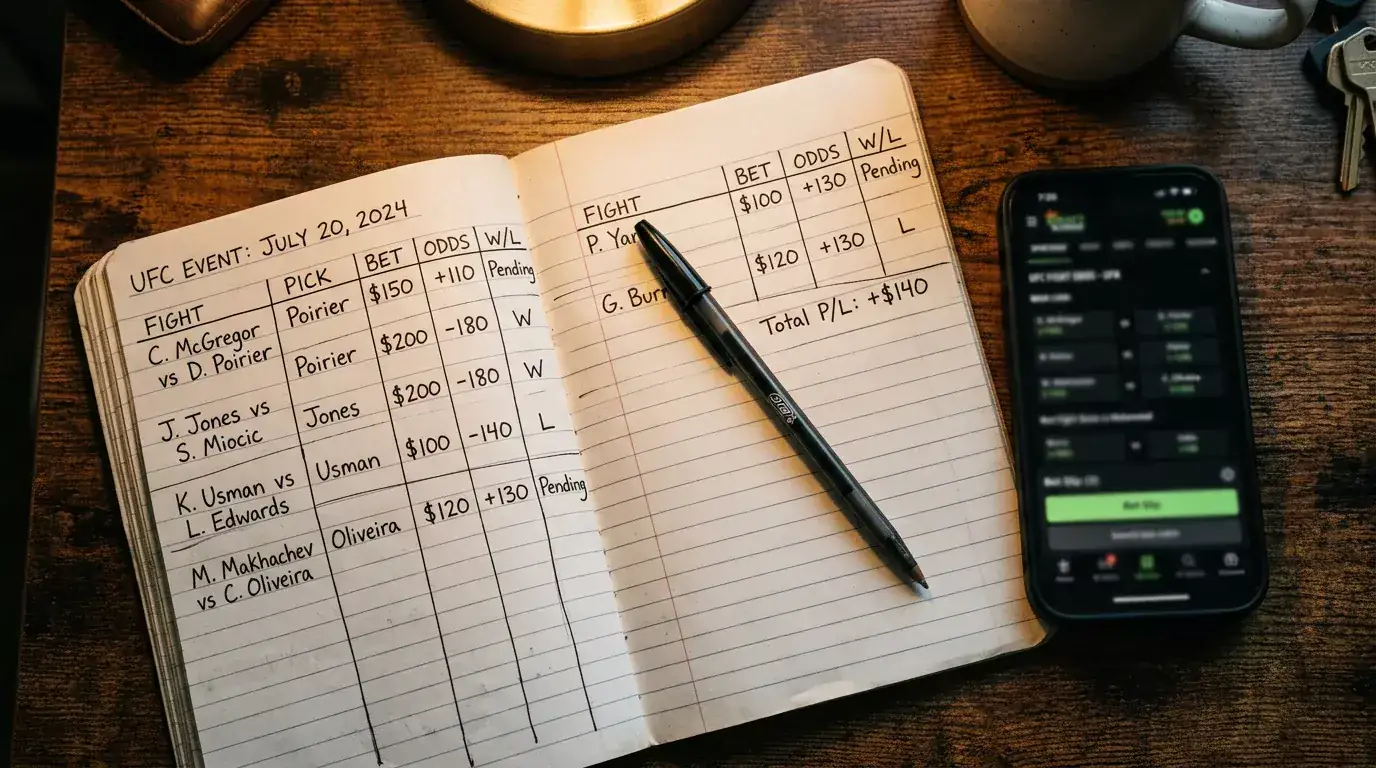
Tracking CLV requires recording three numbers for every bet: the odds you got, the closing odds at fight time, and the outcome. A spreadsheet works. Over fifty or more bets, the pattern becomes clear. If your average odds are consistently better than the closing line, you are a sharp bettor. If your average odds are consistently worse — you bet late and the line moved against you before you placed — you are donating edge to the market.
Not every value bet wins. That is the hardest part of this approach. You will identify fights where the market has mispriced the underdog, bet accordingly, and watch that underdog lose. It happens more often than it does not. The discipline is in trusting the process across a large sample, not in demanding immediate validation from individual results. Value betting is a long game, and the bettors who succeed are the ones who track their CLV, refine their analysis, and stay the course when a losing streak tests their conviction. For a deeper look at how odds formats and implied probability connect to this framework, start with our guide to UFC odds.
How do I calculate expected value for a UFC bet?
Multiply your estimated win probability by the potential profit, then subtract your estimated loss probability multiplied by the stake. If you assess a fighter at 40% to win and the decimal odds are 3.00, the EV per pound is: (0.40 x 2.00 profit) minus (0.60 x 1.00 stake) = 0.80 minus 0.60 = +0.20. A positive number means the bet has positive expected value over the long term.
What is closing line value and why do sharp bettors track it?
Closing line value measures whether you consistently got better odds than the final market price at fight time. If you regularly bet at odds higher than the closing line, it indicates your analysis is identifying mispriced fights before the market corrects. Over a large sample, consistent CLV is the strongest predictor of long-term betting profitability, more reliable than short-term win rates.
Created by the ”how to bet on the ufc Fight” editorial team.