UFC Betting vs Boxing Betting: Key Differences Every Punter Should Know
 Available in US

Two Combat Sports, Two Completely Different Betting Landscapes
If you bet on boxing and you are thinking about crossing over to UFC, the instinct is to assume your skills transfer directly. After all, both sports involve two fighters, a stoppage or a decision, and odds on who wins. But the similarities are surface-level. The structure of the fights, the range of outcomes, the frequency of upsets, and the depth of available betting markets create two fundamentally different wagering environments.
UFC underdogs win approximately 35% of fights — the third-highest upset rate among major betting sports. In boxing, the upset rate is substantially lower, particularly in high-profile bouts where the promoter has matched fighters specifically to produce a marketable result. That single difference changes everything about how you approach value, how you size your bets, and which markets offer the best edges.
Here is a breakdown of the key differences, written for punters who know one sport and want to understand the other. For a full catalogue of the UFC-specific markets mentioned below, the bet types guide covers each one in detail.
Rounds, Judging, and How Fight Length Changes Your Bets
A standard UFC bout is three five-minute rounds — fifteen minutes of fighting. Title fights and main events are five rounds, or twenty-five minutes. A standard boxing match can be anywhere from four to twelve three-minute rounds, with championship fights always set for twelve. That difference in duration has a cascading effect on betting.
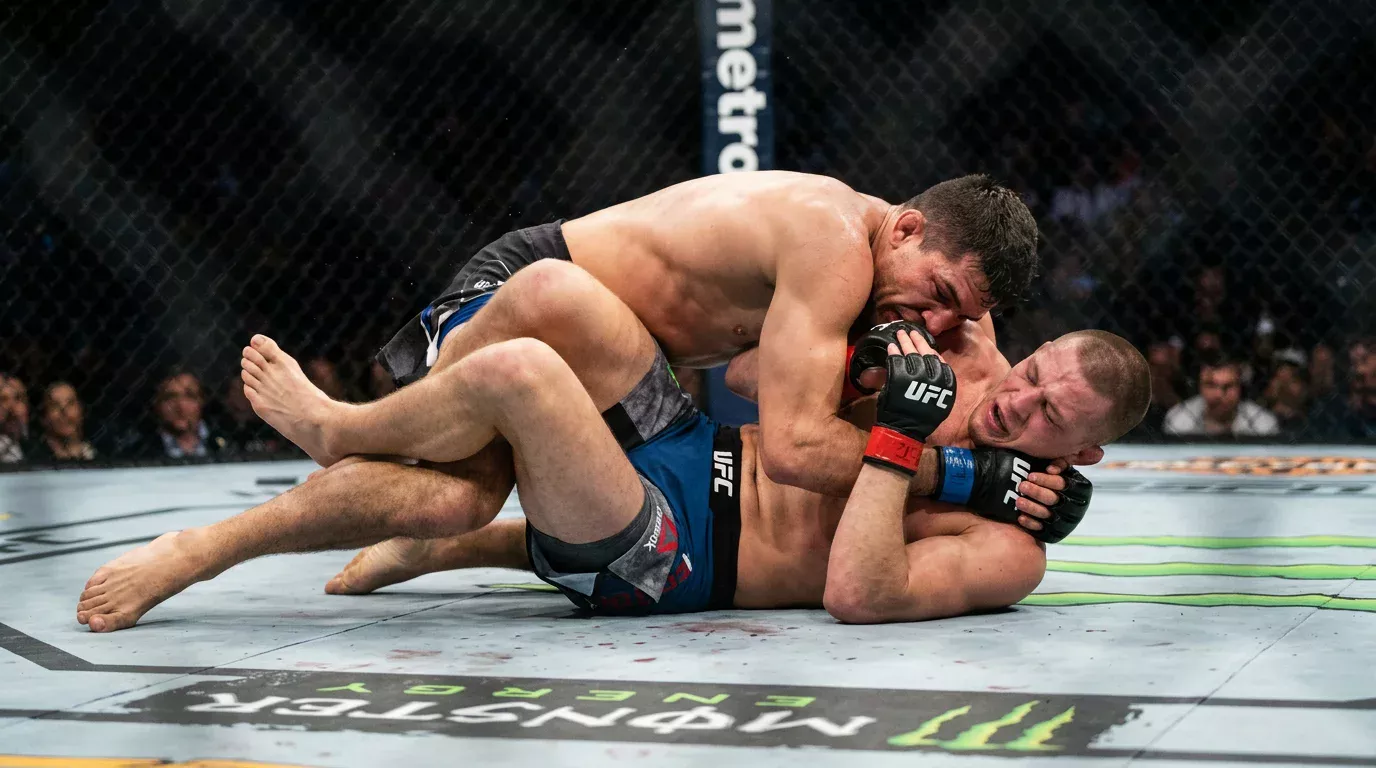
In UFC, the shorter fight length means that a single moment — one punch, one takedown, one submission attempt — can decide the outcome at any point. In 2025, the UFC’s 520 bouts produced 65 knockouts, 103 technical knockouts, and 92 submissions alongside 253 decisions. Nearly half the fights ended by stoppage. In boxing, the 12-round format gives fighters more time to recover from bad moments, and the larger gloves reduce knockout frequency. Decisions are more common in boxing as a proportion of total outcomes, particularly at the higher weight classes where both fighters are skilled enough to survive twelve rounds.
For round betting — predicting the specific round of a finish — the UFC market is wider because the total number of rounds is smaller. Betting on a finish in round two of a three-round fight is a meaningfully different proposition than betting on a finish in round eight of a twelve-round fight. The UFC’s compressed timeframe produces higher odds per round selection but also higher variance, because there are fewer rounds for the outcome to materialise.
Judging differs too. Both sports use the 10-point must system, but UFC judges score across three criteria — striking, grappling, and octagon control — while boxing judges focus primarily on clean punching, effective aggression, defence, and ring generalship. The broader scoring criteria in UFC produce more controversial decisions because reasonable judges can weigh grappling and cage control differently. This affects decision betting: in UFC, split decisions are more frequent than in boxing, which creates opportunities in markets that offer different odds for unanimous versus split outcomes.
Available Markets: Where UFC Offers More and Where Boxing Wins
UFC betting markets have expanded dramatically in recent years, but boxing still holds an edge in certain areas. The key difference is frequency. The UFC runs roughly 42 events per year with 10 to 14 fights each, providing a consistent stream of betting opportunities. Boxing is more sporadic — a major card might feature only three or four bouts, and the gaps between significant events can stretch to months. For bettors who want regular action, UFC provides it in a way boxing does not.
Where UFC excels is in method of victory markets. Because UFC fights can end by KO, TKO, submission, or decision — and the balance between these varies dramatically by weight class — the method of victory market is richer and more analytically interesting than in boxing, where the realistic outcomes are KO/TKO or decision. The submission element in UFC adds an entire dimension that does not exist in boxing betting.
Boxing holds an advantage in round-group betting. With twelve rounds available, bookmakers can offer grouped selections — rounds 1-3, 4-6, 7-9, 10-12 — that provide a middle ground between the precision of exact round betting and the breadth of the moneyline. UFC’s shorter fight length limits these group options, though some sportsbooks do offer round-group markets for five-round UFC bouts.
Props are growing in both sports, but UFC leads. Significant strike totals, takedown numbers, knockdown props, and fight-level specials like Fight of the Night are standard at major UK sportsbooks for UFC. Boxing props tend to be limited to knockdown bets and total rounds, with fewer performance-level options available.
Upset Frequency and What It Means for Value Seekers
This is the single most important difference for bettors. UFC’s 35% underdog win rate creates a structural advantage for bettors willing to back the longer price. In 2024, underdogs at +200 or longer won 39% of their UFC fights — a dramatic spike from the historical average of 28%. Boxing rarely produces anything comparable. The promotional structure of boxing means that many high-profile fights are deliberate mismatches designed to build a fighter’s record, and the upset rate in these bouts is far below the UFC average.
The practical implication is straightforward. In UFC, you can build a profitable long-term strategy around selectively backing underdogs, because the base rate supports it. In boxing, underdog betting is a more surgical exercise — the upsets happen, but they are rarer and harder to predict because the matchmaking process filters out many of the competitive fights before they are booked.
For punters who are comfortable with both sports, this creates an interesting portfolio approach. Use boxing for more conservative favourite-heavy betting where the matchmaking gives you an informational advantage, and use UFC for higher-variance underdog strategies where the sport’s inherent unpredictability works in your favour. The two sports complement each other if you adjust your staking and market selection accordingly.
One final difference worth noting: the data feedback loop. Because the UFC runs consistently throughout the year, you accumulate a sample of 500 or more bets annually — far faster than boxing allows. That volume of data lets you identify patterns in your own performance, refine your approach, and build genuine statistical confidence in your methods. Boxing’s sparser schedule stretches that same learning process across years rather than months, which is a meaningful disadvantage for bettors who want to improve systematically.
Are UFC fights easier to predict than boxing fights?
Not exactly. UFC fights are harder to predict on an individual basis because the range of possible outcomes is wider — a fight can end by KO, TKO, submission, or decision in any round. However, the UFC’s consistent schedule and deeper data make it easier to build systematic approaches over large sample sizes. Boxing is more predictable on a fight-by-fight basis but offers fewer opportunities per year.
Why do UFC underdogs win more often than boxing underdogs?
Several factors contribute. UFC fights are shorter, giving underdogs less time to be ground down by a superior opponent. The range of techniques — striking, wrestling, submissions — creates more paths to an upset. And UFC matchmaking is less protective than boxing promotions, meaning competitive fights are more common. The result is an underdog win rate of roughly 35% in UFC versus a substantially lower figure in boxing.
Published by the how to bet on the ufc Fight team.