
UFC Betting Odds Formats and Probability Converter
 Available in US
Table of Contents
- Analyzing Core UFC Betting Odds Structures
- Fractional Odds: The UK Standard
- Decimal Odds: The European Format
- American Odds: What the Plus and Minus Mean
- Converting Between Odds Formats
- Implied Probability: The Number Behind the Number
- Why UFC Odds Move and What It Means
- Reading Odds Is a Skill — Sharpening It Is the Edge
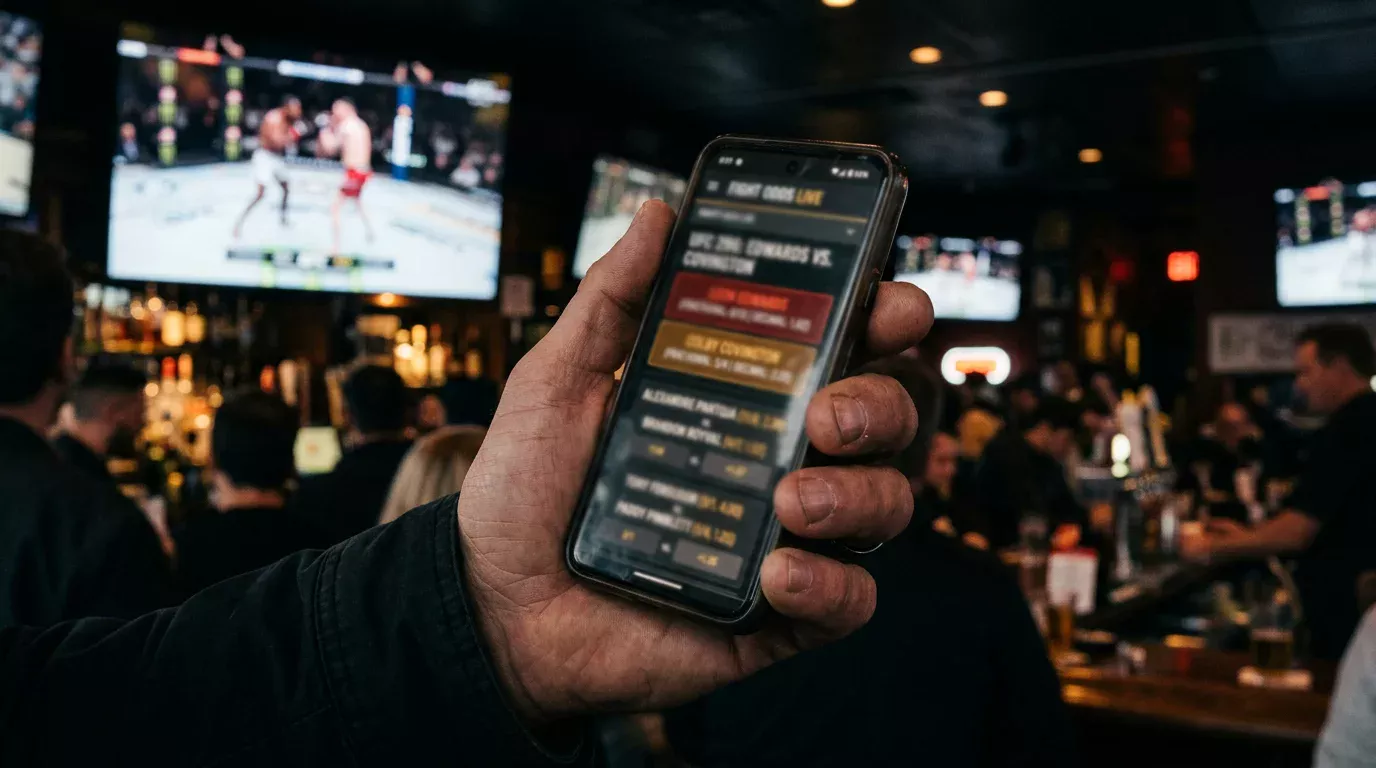
Analyzing Core UFC Betting Odds Structures
I placed my first UFC bet in 2018, and I got the odds completely wrong. Not the pick — the actual reading of the number. I thought 4/1 meant I’d win four pounds if my fighter landed the knockout. It actually meant four pounds for every one pound staked. That misunderstanding cost me nothing except embarrassment, but I’ve watched newer bettors make far more expensive versions of the same mistake.
Odds are the foundation of every decision you’ll make as a UFC bettor. They tell you how much you stand to win, how likely the bookmaker thinks an outcome is, and — most importantly — whether a bet is worth placing at all. In the 2025 UFC season, bookmaker favourites won 342 of 506 fights where a clear favourite existed. That sounds like easy money until you realise the odds on those favourites were often so short that the payouts barely covered the losses from the 164 upsets. The difference between profit and loss wasn’t who won — it was understanding the numbers attached to each fighter’s name.
Three odds formats dominate combat sports betting: fractional, decimal, and American. UK bookmakers default to fractional, European platforms favour decimal, and American sportsbooks use their own plus-and-minus system. Every format expresses the same underlying probability, just in different mathematical clothing. Once you can read all three fluently, you’ll navigate any platform on earth, compare lines across bookmakers in seconds, and spot opportunities that less numerate bettors miss entirely.
This guide breaks down each format with real UFC examples, teaches you the conversions, and then goes further than most resources bother — into implied probability, overround, and what line movement actually signals. Whether you’ve never placed a bet or you’ve been punting on fight nights for years without fully grasping the maths, this is the reference you’ll keep coming back to.
Fractional Odds: The UK Standard
Walk into any Coral, Ladbrokes, or William Hill shop, and the odds board shows fractions. Open bet365 or Betway on your phone with default UK settings, and fractions stare back at you. This is the format most British punters grow up with, even if they never stop to think about what the numbers actually mean.
A fractional odd is written as two numbers separated by a slash: 5/1, 3/2, 1/4. The left number tells you the profit you’ll earn for every unit represented by the right number. At 5/1, you profit five pounds for every one pound staked. At 3/2, you profit three pounds for every two pounds staked. At 1/4, you profit one pound for every four pounds staked. Your original stake always comes back on top of the profit.
Calculating Your Payout in Pounds
The formula is straightforward: Payout = Stake x (Numerator / Denominator) + Stake. Say you back a fighter at 7/2 with a ten pound stake. Profit = 10 x (7/2) = 35. Total payout = 35 + 10 = 45 pounds. That’s it. Every fractional odd you’ll ever see works the same way.
Where people get tripped up is with odds-on prices — fractions where the denominator is larger than the numerator. A fighter priced at 2/7 is a heavy favourite. Your profit for a seven pound stake is only two pounds. The low payout reflects the bookmaker’s view that this outcome is highly probable. In practical terms, you’re risking a lot to win a little, which is fine if the probability justifies it, and a slow bleed on your bankroll if it doesn’t.
Why Fractions Matter for UFC Specifically
UFC odds swing harder than most sports. A Premier League match might see the favourite priced at 4/6. A UFC headliner can feature a favourite at 1/8 and the underdog at 5/1 on the same card. That range demands comfort with both ends of the fractional spectrum. And because all gambling winnings in the UK are completely tax-free — the bookmaker pays the tax, not you — every penny of that calculated payout lands in your account without deduction. It’s one of the genuine advantages of betting from this side of the Atlantic.
One more thing worth noting: some bookmakers display fractional odds that don’t reduce neatly. You might see 11/8 instead of a cleaner fraction. Don’t let that throw you. The calculation is identical. Stake times numerator divided by denominator equals profit. Always.
Decimal Odds: The European Format
The first time I switched my Betfair account to decimal odds, everything suddenly felt simpler. Decimal odds represent the total return for every pound staked, including your original stake. A price of 3.50 means a one pound bet returns 3.50 pounds total — 2.50 profit plus your one pound back. No fractions, no separate mental step to add the stake.
Most European sportsbooks, betting exchanges, and Asian-facing platforms use decimals as the default. An increasing number of UK bettors prefer them too, especially those who use exchanges like Betfair or Smarkets. The format makes comparing odds across different fighters or different bookmakers faster because every number sits on the same scale. A fighter at 1.25 is a heavier favourite than one at 1.80, which is a heavier favourite than one at 2.10 — no fraction-to-decimal mental gymnastics required.
How to Calculate Your Return
Total Return = Stake x Decimal Odds. Profit = Total Return – Stake. That’s the entire system. A 20 pound bet at 4.00 returns 80 pounds (60 profit, 20 stake back). A 20 pound bet at 1.15 returns 23 pounds (3 profit, 20 stake back). The lower the decimal, the shorter the price and the more likely the bookmaker considers that outcome.
Decimals also make parlay calculations trivial. Multiply the decimal odds of each selection together, then multiply by your stake. Three fighters at 1.50, 2.00, and 1.80 give you a combined decimal of 5.40. A ten pound stake returns 54 pounds. Try doing that with 1/2, Evens, and 4/5 in your head. Decimals win every time for multi-leg bets.
The 2.00 Line
In decimal format, 2.00 is the dividing line between favourites and underdogs. Below 2.00, the bookmaker believes the outcome is more likely than not. Above 2.00, it’s considered less likely. Exactly 2.00 is an even-money shot — a coin flip in the bookmaker’s estimation, before their margin is factored in. In UFC terms, pick’em fights priced at or near 2.00 on both sides are rare and usually signal a genuinely close matchup where the oddsmakers can’t separate the two fighters.
American Odds: What the Plus and Minus Mean
If you’ve ever scrolled MMA Twitter or Reddit and seen numbers like -250 or +180 next to fighter names, those are American odds. They look alien to UK eyes at first, but they show up constantly in UFC coverage because the sport’s heartland is the United States, and most English-language betting content originates there.
The system splits into two halves. A minus sign (-) denotes the favourite and tells you how much you need to stake to win 100 units. A fighter at -250 requires a 250 dollar (or pound, or any currency) wager to profit 100. A plus sign (+) denotes the underdog and tells you how much you’d profit from a 100 unit stake. A fighter at +180 returns 180 profit on a 100 stake.
Reading the Numbers in Practice
Think of it this way: the minus number answers “how much do I risk to win a hundred?” and the plus number answers “how much do I win if I risk a hundred?” The bigger the minus number, the heavier the favourite. A -600 fighter is expected to win far more often than a -150 fighter. The bigger the plus number, the longer the shot. A +500 underdog is a distant outsider; a +110 underdog is nearly a coin flip.
You won’t need American odds for placing bets at UK bookmakers — every UKGC-licensed platform offers fractional or decimal as standard. But you absolutely need to understand them for consuming UFC analysis, following line movement discussions, and using data from American-centric sources. When a podcast host says “he opened at -300 and has moved to -220,” that shift carries real information about where money is flowing and how the market perceives the fight. Ignoring that signal because you don’t speak the format is leaving edge on the table. Once you understand how to read the odds, it is essential to explore the various UFC betting markets available for every major fight card.
The -110 Baseline
In American sportsbooks, -110 on both sides of a bet is the standard “even” line with the house margin baked in. You’ll see this on over/under rounds and some prop markets. It means you stake 110 to win 100 — the extra 10 is effectively the bookmaker’s commission. Recognising -110 as the baseline helps you gauge whether a line carries heavier or lighter juice than normal.
Converting Between Odds Formats
I keep a small cheat sheet pinned to my monitor. Not because the conversions are difficult, but because doing them quickly — mid-podcast, mid-article, mid-live-event — separates useful analysis from wasted time. Here are the formulas that matter.
Fractional to Decimal
Divide the numerator by the denominator and add 1. Fractional 5/2 becomes (5 / 2) + 1 = 3.50 decimal. Fractional 1/4 becomes (1 / 4) + 1 = 1.25 decimal. That trailing “+ 1” accounts for getting your stake back, which decimal odds include and fractional odds don’t.
Decimal to Fractional
Subtract 1 from the decimal, then express the result as a fraction. Decimal 4.00 becomes 3/1. Decimal 1.50 becomes 1/2. Some decimals produce messy fractions — 2.75 becomes 7/4 — but bookmakers handle the display for you. The skill is knowing both numbers represent the same price.
American to Decimal
For positive American odds: (American / 100) + 1. So +200 becomes 3.00. For negative American odds: (100 / absolute value of American) + 1. So -250 becomes (100 / 250) + 1 = 1.40.
Decimal to American
If decimal is 2.00 or above: (Decimal – 1) x 100 = positive American. Decimal 3.50 becomes +250. If decimal is below 2.00: -100 / (Decimal – 1) = negative American. Decimal 1.40 becomes -250.
Why This Fluency Matters
Real-world example: you’re reading an American MMA analyst who says a fighter at +180 is good value. Your UK bookmaker shows the same fighter at 11/4. Is the UK book offering better or worse odds? Convert +180 to decimal: (180/100) + 1 = 2.80. Convert 11/4 to decimal: (11/4) + 1 = 3.75. The UK bookmaker is offering significantly better odds. Without conversion fluency, you’d never have spotted that gap. And in a sport where the margins between profit and loss are razor-thin, that gap is everything.
Most modern bookmaker apps let you toggle between formats with a single tap in settings. I recommend doing your analysis in decimals — they’re the cleanest for calculations — and switching to whatever format your platform uses when you actually place the bet.
Implied Probability: The Number Behind the Number
Here’s where most UFC betting guides stop, and here’s exactly where things start to get useful. Every set of odds contains a hidden percentage — the bookmaker’s estimate of how likely that outcome is. Extracting that percentage is the single most important numerical skill in betting, and it takes about ten seconds once you know the formula.
The Formula
For decimal odds: Implied Probability = 1 / Decimal Odds x 100. A fighter priced at 1.50 has an implied probability of 66.7%. A fighter at 4.00 has an implied probability of 25%. That’s what the bookmaker’s market is saying: “we believe this fighter wins roughly one in four times.”
For fractional odds: Implied Probability = Denominator / (Numerator + Denominator) x 100. A fighter at 1/3 has an implied probability of 75%. For American odds, the calculation differs by sign. Negative: Absolute value / (Absolute value + 100) x 100. So -300 implies 75%. Positive: 100 / (American + 100) x 100. So +200 implies 33.3%.
What the Numbers Mean for Your Bets
UFC favourites in the -400 to -900 range have historically won at rates between 88% and 93% since 2013. That sounds like a safe bet until you run the implied probability. A fighter at -400 (decimal 1.25) carries an implied probability of 80%. If they actually win 88% of the time, there’s a gap — the real probability exceeds the implied probability, and that gap represents potential value. But a fighter at -900 (decimal 1.11) carries an implied probability of 90%. If they win 93% of the time, the gap narrows to almost nothing, and the tiny payout makes a single loss devastating to your bankroll.
In 2024, UFC favourites won 72% of their fights overall. A fighter priced at decimal 1.40 carries an implied probability of 71.4%. If you believe the true probability is 72%, the value is negligible — the bookmaker has priced the market almost perfectly. This is the brutal truth about favourite-heavy betting: the margins are thin, and the bookmaker’s model is usually close to right.
The Overround: The Bookmaker’s Built-In Edge
Add up the implied probabilities of all outcomes in a UFC fight and you’ll get a number above 100%. A two-way moneyline market might show Fighter A at 1.45 (69%) and Fighter B at 3.00 (33.3%), totalling 102.3%. That extra 2.3% is the overround — the bookmaker’s margin. It guarantees the book a profit over time regardless of outcome. The lower the overround, the fairer the market for the bettor. Comparing overrounds across bookmakers is one of the quickest ways to find better value, and it’s something I check before every card.
Exchange platforms like Betfair typically run tighter overrounds than traditional bookmakers because the exchange earns commission on winning bets rather than building a margin into the odds. For UFC markets with enough liquidity, exchanges often offer the sharpest prices available to UK bettors.
Why UFC Odds Move and What It Means
Last year I watched a co-main event line open with the favourite at 1.55 and close at 1.30 on fight night. The fighter won by first-round TKO. Was the line movement a prediction? Not exactly — but it carried a message that anyone paying attention could have read.
Odds move for two primary reasons: money and information. When a disproportionate volume of bets lands on one side, bookmakers adjust the line to balance their liability. If thousands of punters back Fighter A, the bookmaker shortens Fighter A’s odds and lengthens Fighter B’s to attract money on the other side. This is pure market mechanics, and it doesn’t necessarily mean Fighter A is more likely to win — just that more people think so.
The second driver is information. A training camp injury, a change of opponent, a viral sparring clip, a weigh-in where one fighter looks drawn and depleted — any of these can shift odds sharply. Sharp bettors — those with track records of profitability — also move lines. Bookmakers pay close attention to accounts flagged as sharp, and when sharp money hits one side, the line reacts before the broader public even notices.
What to Watch For
MMA’s underdog win rate sits at roughly 35% — the third-highest among major betting sports. That structural unpredictability means line movement in UFC is often more volatile than in football or tennis. A football match might see the favourite drift from 1.50 to 1.55 over a week. A UFC headliner can swing from 1.60 to 2.00 in 48 hours if camp news breaks. The OwnTheLines research team has noted that the sport’s structure creates variance other sports simply cannot match, and that variance shows up directly in the odds market.
Pay attention to the direction and timing of movement. Early movement — days before the fight — often comes from sharp money or informed bettors acting on camp intelligence. Late movement — in the hours before the walkouts — is usually driven by public money flooding in after media coverage, podcast picks, and social media hype. Neither direction is automatically right, but understanding which type of money is driving the shift helps you decide whether to follow the movement or fade it.
Steam Moves and Reverse Line Movement
A steam move is a sharp, sudden shift across multiple bookmakers simultaneously. It almost always signals professional money and is one of the strongest predictive indicators in any sport. Reverse line movement is the opposite: the line moves against the side receiving the majority of bets. If 70% of public bets are on Fighter A but the line drifts in Fighter B’s favour, the bookmaker is telling you that the smaller volume of sharp money on Fighter B outweighs the public’s enthusiasm. These signals aren’t guarantees, but they’re among the most reliable edges available to bettors who know how to read odds beyond the surface number.
For a deeper look at turning these signals into actionable bets, our guide to UFC value betting walks through expected value calculations and closing line analysis step by step.
Reading Odds Is a Skill — Sharpening It Is the Edge
Most bettors treat odds as a price tag — something you glance at before deciding whether to buy. The bettors who last long enough to turn a profit treat odds as a language, one that communicates probability, margin, market sentiment, and opportunity in a single number. Fractional, decimal, or American — the format is just a dialect. The underlying message is always the same: here’s what the market believes, and here’s where it might be wrong.
Start by picking one format and getting comfortable with payout calculations until they’re automatic. Then learn the conversions so you can consume analysis from any source worldwide. Finally, move into implied probability and line movement — the territory where reading odds stops being arithmetic and starts becoming an edge. Every bet you’ll ever place begins with a number. Make sure you understand what that number is actually telling you before you risk a single pound on it. For the most accurate predictions and pre-fight analysis, always consult our premier MMA betting guide before placing your wagers.
What do fractional odds like 5/1 actually mean for a UFC bet?
Fractional odds of 5/1 mean you profit five pounds for every one pound staked. If your fighter wins and you bet ten pounds, your profit is fifty pounds and your total return is sixty pounds including the stake. The left number is always the profit, the right number is always the stake required to earn that profit.
Why do UFC odds change between the opening line and fight night?
Odds move for two reasons: betting volume and new information. When heavy money lands on one fighter, bookmakers shorten that fighter’s odds to balance their liability. Information shifts — training camp injuries, weight cut issues, coaching changes — also trigger adjustments. Sharp bettors with profitable track records can move lines particularly fast because bookmakers respect their positions.
How do I calculate my potential profit from UFC odds in pounds?
For fractional odds, multiply your stake by the numerator divided by the denominator. A ten pound bet at 7/2 returns 35 pounds profit plus your ten pound stake back. For decimal odds, multiply your stake by the decimal and subtract your original stake. A ten pound bet at 4.50 returns 45 pounds total, which is 35 pounds profit. All winnings are tax-free for UK bettors.
What is the overround and how does it affect UFC odds?
The overround is the bookmaker’s built-in margin. Add up the implied probabilities of all outcomes in a market — if Fighter A implies 69% and Fighter B implies 33%, the total is 102%. That extra 2% is the overround. A lower overround means fairer odds for the bettor. Comparing overrounds across bookmakers helps you find the best available price on every UFC fight.
Created by the ”how to bet on the ufc Fight” editorial team.