UFC Prediction Markets: How Polymarket and Similar Platforms Work
 Available in US
UFC Is Now Officially Partnered with a Prediction Market
In November 2025, the UFC announced a multi-year partnership with Polymarket as its exclusive prediction market partner. This was not a peripheral sponsorship deal. It was a signal that prediction markets — platforms where users trade event contracts rather than place traditional bets — have become a legitimate part of the combat sports betting ecosystem.
Dana White framed the broader relationship between UFC and wagering clearly: regulated sports betting has become deeply integrated into modern professional sports, driving audience engagement, sponsorship revenue, and media value. The Polymarket partnership extends that integration into a new format that operates differently from the sportsbooks most UK bettors are familiar with.
For UK-based UFC bettors, prediction markets are worth understanding even if you never trade on one directly, because they provide an independent pricing mechanism that can reveal value in traditional bookmaker odds. Here is how they work and how they fit alongside the sportsbook markets covered in the value betting guide.
Prediction Markets vs Traditional Bookmakers: Side by Side
A traditional bookmaker sets odds on a fight outcome and takes the other side of your bet. The bookmaker builds a margin — the overround — into the odds, guaranteeing themselves a profit regardless of the result. Your counterparty is the bookmaker.
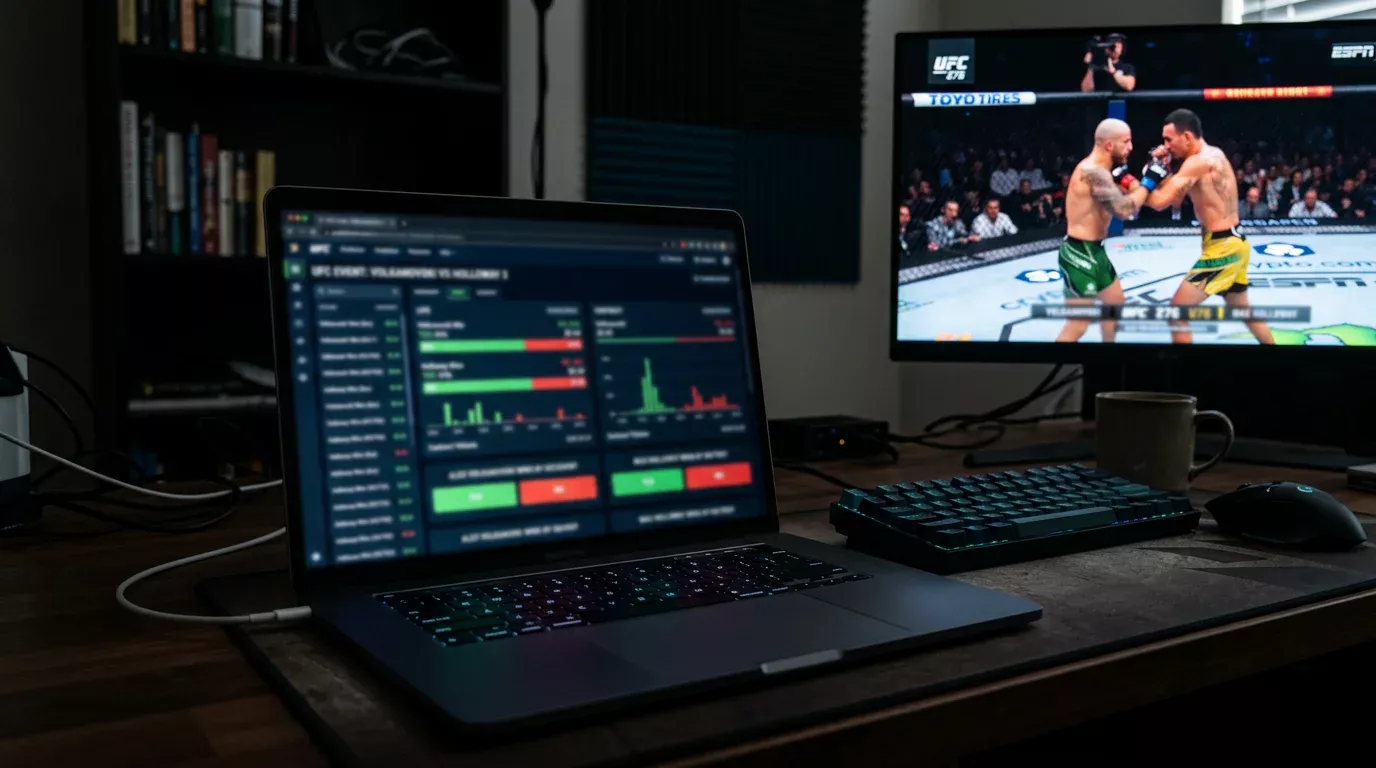
A prediction market works more like a stock exchange. Each outcome is represented by a contract priced between 0 and 100 cents (or pence, depending on the platform’s currency). If you believe Fighter A will win and the contract is priced at 62 cents, you buy it at 62. If Fighter A wins, the contract settles at 100 cents and you profit 38 cents per contract. If Fighter A loses, it settles at zero and you lose your 62-cent stake. Someone else sold you that contract at 62, because they believed Fighter A would lose.
The price of the contract is the market’s implied probability. A contract at 62 cents implies a 62% chance of the outcome occurring. Unlike a bookmaker’s implied probabilities, which sum to more than 100% because of the overround, prediction market prices for a binary outcome should sum to close to 100 cents — the spread between the two sides representing the platform’s transaction fee rather than a built-in margin.
This structural difference matters. Because prediction markets match buyers and sellers rather than taking positions, the prices are theoretically more efficient — they represent the aggregate belief of all participants rather than the risk management decisions of a single bookmaker. In practice, the efficiency depends on the volume of trading. For major UFC title fights, Polymarket attracts enough volume to produce sharp prices. For prelim bouts or smaller events, the volume may be too thin for the prices to be reliable.
Can UK Residents Use UFC Prediction Markets?
This is the question that matters most for readers of this site, and the answer is complicated. Polymarket is not licensed by the UK Gambling Commission and does not hold a UKGC licence. As of 2026, UK residents face significant restrictions on accessing prediction market platforms that are not regulated under UK gambling law.
The broader UK regulatory environment is moving in a direction of tighter control. Since April 2025, the UK has introduced a statutory gambling levy of 0.1% to 1.1% on operator revenue, replacing the old voluntary contributions. This levy applies to UKGC-licensed operators, and its introduction reflects the Commission’s view that all gambling activity within the UK market should be regulated and contribute to research, education, and treatment for gambling-related harm. Unregulated prediction platforms sit outside this framework.
The practical reality is that some UK residents do access prediction markets through VPNs or by holding cryptocurrency on platforms that do not enforce geographical restrictions. I am not going to tell you this is legal, because the regulatory position is ambiguous and potentially in breach of UK gambling laws. What I will say is that using a UKGC-licensed sportsbook is the only approach that gives you full legal protection, complaint resolution through the Alternative Dispute Resolution process, and confidence that your funds are segregated and safe.
If you want the analytical benefits of prediction market prices without the legal ambiguity, the next section explains how to use them as a reference tool rather than a trading platform.
Using Prediction Market Prices to Spot Value in Bookmaker Odds
Even if you never trade a prediction market contract, the prices are publicly visible and can serve as an independent check on your bookmaker’s odds. If Polymarket prices a fighter’s win probability at 58% and your bookmaker’s implied probability is 65%, the discrepancy is worth investigating. It does not automatically mean the bookmaker is wrong — prediction market participants may have different information or biases — but a consistent gap between the two pricing mechanisms can highlight opportunities.
The approach works best for high-profile fights where both the prediction market and the sportsbook have sufficient volume to produce reliable prices. For lower-profile fights, the prediction market may be too thinly traded to offer a meaningful signal, and the sportsbook odds — shaped by the bookmaker’s own modelling and the weight of sharp bettor money — are likely more accurate.
I use prediction market prices as one input among several. If my own analysis suggests a fighter has a 55% chance of winning, the bookmaker implies 60%, and the prediction market prices it at 53%, the convergence between my assessment and the prediction market gives me more confidence in the value of the sportsbook bet. If all three numbers agree, there is no edge. The value lives in the divergence, and having multiple independent price sources makes it easier to spot.
One caveat: prediction market prices move in real time based on trading activity, and they can be influenced by large positions that do not necessarily reflect informed opinion. A single trader placing a large order can move a thinly traded contract significantly. Cross-reference the prediction market price with the time it was observed and the volume traded — a 58-cent contract with 50,000 pounds in total volume is a more reliable signal than one with 500 pounds.
As prediction markets mature and the UFC’s partnership with Polymarket deepens, the pricing data available to bettors will only improve. Whether or not you ever trade a contract directly, incorporating prediction market prices into your pre-fight analysis adds an independent perspective that can sharpen your ability to spot value at the sportsbook — and in a market where edges are increasingly thin, that additional input can make a measurable difference over time.
Is Polymarket legal for UFC betting in the UK?
Polymarket does not hold a UK Gambling Commission licence. UK residents face restrictions on using prediction market platforms that are not regulated under UK law. The regulatory position is evolving, and using unregulated platforms may breach UK gambling laws. UKGC-licensed sportsbooks remain the only fully legal and protected option for UK-based UFC betting.
How do UFC prediction market prices compare to bookmaker odds?
Prediction market prices represent implied probabilities without the bookmaker’s overround, so they tend to be slightly different from sportsbook odds. For high-profile UFC fights with significant trading volume, prediction market prices can be a useful independent reference point. Comparing them to bookmaker odds can highlight discrepancies that suggest value. For lower-profile fights, prediction market liquidity is often too thin for the prices to be reliable.
Created by the ”how to bet on the ufc Fight” editorial team.