UFC Prop Bets and Performance Market Specials
 Available in US
Reviewing Performance and Card-Level Proposition Markets
The first UFC prop bet I ever placed was on a knockdown in the first round of a heavyweight bout. It lost — the fight ended by submission in round two — but the experience opened a door I have never closed. Prop bets let you wager on specific events within a fight rather than the overall outcome, and in a sport where 520 bouts produced 65 knockouts, 103 technical knockouts, 92 submissions, and 253 decisions across a single calendar year, the range of things you can bet on is enormous.
Proposition markets have grown steadily as bookmakers realised that UFC audiences want to engage with fights on a granular level. In 2025 the UFC staged 42 events across 26 cities and 12 countries, generating nearly 94 hours of cage time — every second of which created data that feeds into prop pricing. You are no longer limited to picking a winner. You can bet on how many significant strikes a fighter will land, whether there will be a knockdown, how many takedowns will be attempted, and dozens of other micro-outcomes.
If you already understand the core UFC bet types, props are the next layer. They reward the kind of detailed fight analysis that moneyline bets do not always reflect, and they can offer value in spots where the main markets are priced efficiently.
Performance Props: Knockdowns, Takedowns, and Significant Strikes
Performance props are the bread and butter of the UFC proposition market. These bets ask you to predict specific statistical outcomes — will Fighter A land over 2.5 knockdowns, will there be a takedown in round one, will total significant strikes exceed a certain threshold. The numbers are set by the sportsbook based on historical averages, matchup dynamics, and stylistic tendencies.
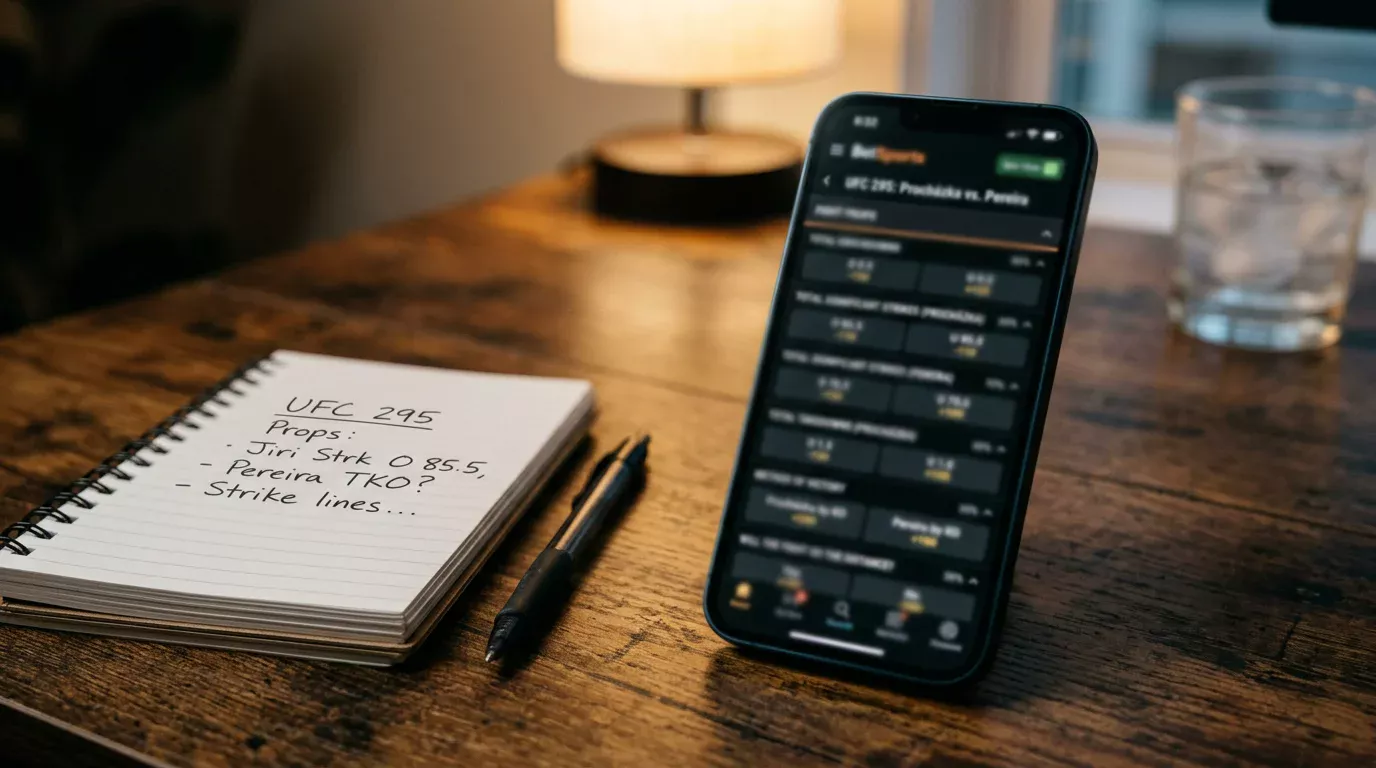
Significant strike totals are the most commonly offered performance prop. Bookmakers set an over/under line — say, 85.5 total significant strikes in the fight — and you bet on which side you think the action will fall. The key to finding value here is understanding pace. Two high-volume strikers in a three-round fight will produce a very different strike count than a wrestler facing a counter-striker. Looking at strikes absorbed per minute is just as important as strikes landed per minute, because a fighter who absorbs a lot usually does so because they stay in the pocket and trade.
Knockdown props tend to carry longer odds because knockdowns are relatively rare events. Across the 520 UFC fights in 2025, the 65 KOs and 103 TKOs included knockdowns, but many fights — particularly those ending by submission or decision — featured none at all. When a knockdown prop appears at plus-money odds in a heavyweight bout, the probability is higher than in a flyweight matchup, but the bookmaker knows that too. The edge comes from identifying specific matchups where one fighter’s defensive habits create vulnerability — a high guard that drops under body shots, or a tendency to lean back rather than move laterally.
Takedown props work similarly. The over/under line might be set at 1.5 or 2.5 takedown attempts in the fight. If you know that one fighter averages 4.2 takedown attempts per fifteen minutes and the other has a 55% takedown defence rate, you can model the expected volume and compare it to the line. The mistake most bettors make is looking at takedown averages without considering how the specific matchup changes the approach. A dominant wrestler facing another strong grappler may actually attempt fewer takedowns than usual, because the risk-reward shifts when you know the opponent can reverse position. One of the most popular proposition markets involves predicting the exact method of victory, whether it be by knockout, submission, or judges’ decision.
Fight Specials: Fight of the Night, Bonus Awards, and Card Totals
Fight specials sit in a different category because they depend not just on the action in the cage but on external judgements. Fight of the Night and Performance of the Night bonuses are awarded by UFC officials after the event, and while spectacular finishes and high-volume exchanges obviously increase the chances, the decision carries a subjective element that makes these props inherently harder to model.
That said, patterns exist. Main events and co-main events receive Fight of the Night bonuses disproportionately often, partly because they are five-round fights with more time for drama and partly because the UFC’s broadcast partners highlight those bouts most heavily. If you are betting on which fight will win the bonus, weighting your assessment toward the top of the card is a reasonable starting point.
Card-level props are a newer addition. These ask questions about the entire event rather than individual fights — how many bouts will end by stoppage, will there be a submission on the card, will any fight go to a split decision. These aggregate props can be modelled using division-level finish rates and the specific fighters on the card. A card stacked with heavyweights and light heavyweights will lean toward stoppages; a card dominated by flyweights and bantamweights will lean toward decisions.
Novelty and Cross-Fight Props on Big Cards
Major UFC events — the numbered pay-per-views and now the Paramount+ headliners — occasionally feature novelty props that stretch beyond standard fight analysis. These might include whether a specific walkout song will be played, the colour of a fighter’s shorts, or how long the post-fight interview will last. I treat these as entertainment bets, not serious edges. The information asymmetry is too high and the pricing is usually soft in the bookmaker’s favour.
Cross-fight props are more interesting analytically. A sportsbook might offer a line on whether the combined fight time of two specific bouts will exceed a certain number of minutes. Or you might see a prop asking whether more bouts on the main card will end by KO/TKO than by decision. When UFC 326 drew 2.5 million viewers on CBS — the highest linear audience in a decade — the bookmakers rolled out an unusually deep slate of cross-fight props for the event, and some of them carried edges because the pricing models were still being calibrated for the new audience size and betting volume.
The general rule with novelty and cross-fight props: the newer the market, the less refined the pricing. When a sportsbook introduces a prop type for the first time on a big card, the margins tend to be wider but the line itself can be softer. If you have done your homework on the specific fighters involved, these markets occasionally offer better value than the more established prop lines that have been sharpened over years of data. Enhance your overall strategy by checking the latest insights on our expert UFC betting hub before the main event begins.
What are UFC prop bets and how do they work?
Prop bets — short for proposition bets — let you wager on specific events within a UFC fight rather than just who wins. Examples include whether there will be a knockdown, how many significant strikes will be landed, or whether the fight will earn a performance bonus. You pick a side (over or under a number, yes or no), and the bet settles based on the official fight statistics.
Are UFC prop bets available at UK-licensed bookmakers?
Yes, most major UKGC-licensed sportsbooks offer UFC prop markets, though the depth varies. Larger operators tend to list performance props like significant strike totals and takedown lines for main card fights, while smaller bookmakers may limit props to high-profile events. The range is expanding as UFC betting volume grows in the UK market.
Published by the how to bet on the ufc Fight team.